
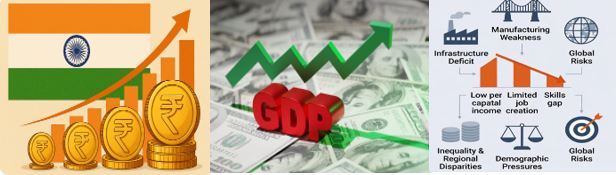
India Overtakes Japan- Becomes World’s 4th Largest Economy. What About Per Capita Income?
India has officially surpassed Japan to emerge as the world’s 4th-largest economy, with a nominal GDP of $4.18 trillion, according to the Government of India’s year-end economic review. This remarkable achievement positions the South Asian powerhouse just behind the United States, China, and Germany in the global pecking order. With robust growth momentum and favorable tailwinds, India is poised to push down Germany and secure 3rd place by 2030.
India recorded 8.2% real GDP growth in the second quarter of fiscal year 2025-26, the highest in the last six quarters. This momentum is the result of a strong economic recovery that has been continued for several years since the covid pandemic, driven by investment, secured domestic material consumption, and growth in industry and services.
Strong Domestic Demand & Private Consumption
India is not entirely an export dependent country. Primarily, India’s economy is powered by strong domestic material consumption. This domestic demand keeps on protecting Indian economy amid global uncertainties time to time. Many international publications describe this period as India’s Goldilocks period which is characterized by sustainable growth and low inflation.
India’s real GDP grew by 8.2% in the second quarter of fiscal year 2025-26, up from 7.8% in the previous quarter and marking the highest level in six quarters. In November, merchandise exports rose to $38.13 billion, up from $36.43 billion in January. The increase was driven by engineering goods, electronics, pharmaceuticals, and petroleum products.
The employment scenario has also improved, with the unemployment rate falling to 4.7 percent in November, the lowest since April 2025. The Reserve Bank of India has raised its GDP growth forecast for 2025-26 to 7.3 percent from 6.8 percent. Analysts believe the reason for this positive outlook is strong domestic demand, tax reforms, lower crude oil prices, an acceleration in government capital expenditure, and supportive monetary policies, which are supported by a decline in inflation.

Is India becoming 4th largest economy Significant?
Yes & No. The cancer is low per capita income combined with other socioeconomic worries. However, it is a praiseworthy milestone.
Japan remained in 2nd to 4th place for decades. India overtaking it is an indication of the rise of emerging major economies, a shift in the dynamics of global consumption, a rebalancing of the drivers of global growth towards the Global South. Certainly, this is not a statistical anomaly; it reflects fundamental and sustained changes in India’s economic structure and growth.
India’s growing economic strength strengthens its voice in global institutions like the IMF, World Bank, WTO, and G20. A higher GDP ranking bolsters India’s ability to shape global trade rules, development financing standards, climate policies, and digital governance frameworks.
“We are the fourth-largest economy as I speak. We are a $4 trillion economy as I speak, and this is not my data. This is IMF data. India today is larger than Japan.”
BVR Subrahmanyam, Chief, Niti Ayog
Overtaking Japan in nominal GDP sends a powerful market signal to global investors, sovereign wealth funds, rating agencies, and multinational corporations. Ranking among the top four in GDP increases India’s influence in bilateral and regional trade negotiations. Because of India’s growing market size, countries and blocs (the European Union, ASEAN, the Gulf region, the African Union) are more willing to negotiate favorable market access, technology transfer, and supply chain partnerships.
China has lauded this milestone achieved by India. A Rival’s praise speaks for itself.
Delighted to know that India is poised to surpass Japan to become the world’s 4th largest economy. India’s rise shows that true strength comes from facing history honestly, learning from it, and taking responsibility for the future.
Spokesperson, Chinese Embassy in India
India’s journey in next 15 Years:
India’s journey in next 15 years will be shaped by GST reforms, digital infrastructure for public, insolvency reforms. India will gain massive benefits from its largest working age population in the coming decade which will propel the productivity in the right direction, provided India continues & improve on employment & opportunities.
In geopolitics, India’s independent foreign policy is expanding a unique footprint globally and at the same time the world looks at India as an alternative manufacturing base, other than China.
India’s IT, financial services, and digital economy continue to outperform global peers. UBS and S&P Global have said that India could structurally benefit from supply-chain relocations.
Diversification into high‑value manufacturing (electronics, pharmaceuticals) will drive India’s external-sector strength. Given these factors, Goldman Sachs and others estimate India could reach USD 10–12 trillion economy by early 2040s
Can India Sustain this Milestone? What are the Challenges?
India, with a population now of about 1.4 billion, world’s most populous nation, is at a critical economic turning point as it seeks to transform the vast size of its population into sustainable growth. Despite becoming the world’s 4th-largest economy, the country’s per capita GDP in 2024 was just $2,694, significantly lower than that of developed economies. According to World Bank data, India’s per capita income is 1/12th of Japan’s roughly $32,487 and 1/20th of Germany’s about $56,103. This delta reflects long-standing structural challenges. Productivity levels are way behind China and Japan, and most of the workforce operates with limited technical knowledge in both the manufacturing and service sectors.
Despite India’s rapid economic growth, its 1.4 billion population has not benefited equally, resulting in significant income inequality. A large share of the nation’s wealth is concentrated in high-income urban groups, who benefit from skilled employment, formal-sector jobs, and access to modern industries.
In contrast, a significant portion of the population is engaged in low-productivity agriculture, informal work, or small-scale enterprises, which yield relatively low and unstable incomes. Regional disparities deepen this divide, states with strong industrial bases and better infrastructure experience higher wages and rapid growth, while other states are left behind. This imbalance means that despite rapid growth in India’s overall GDP, income growth is not uniform, limiting improvements in per capita income for a large segment of its citizens.

With one of the world’s youngest working age population, India must urgently expand access to high‑quality, well‑paid employment, particularly in sectors that can generate large‑scale industrial jobs such as semiconductors, electronics, automobiles, and defence manufacturing. At the same time, the country stands at a crucial juncture in advancing female workforce participation, an area where India trails global competitors. Closing this gap could unlock massive gains in national productivity, raise household incomes, and support more inclusive economic growth.
The coming decade will also test India’s ability to capitalize on the opportunities arising from the shift in global supply chains, as multinational companies aim to diversify out of China. If India wants to establish its strong position as a global manufacturing hub, it will be crucial to accelerate investment-friendly reforms, improve logistics and technology, and increase domestic manufacturing capacity. A comprehensive skills development program that aligns the capabilities of the youth with the needs of advanced manufacturing and technology-based industries will also be essential.