
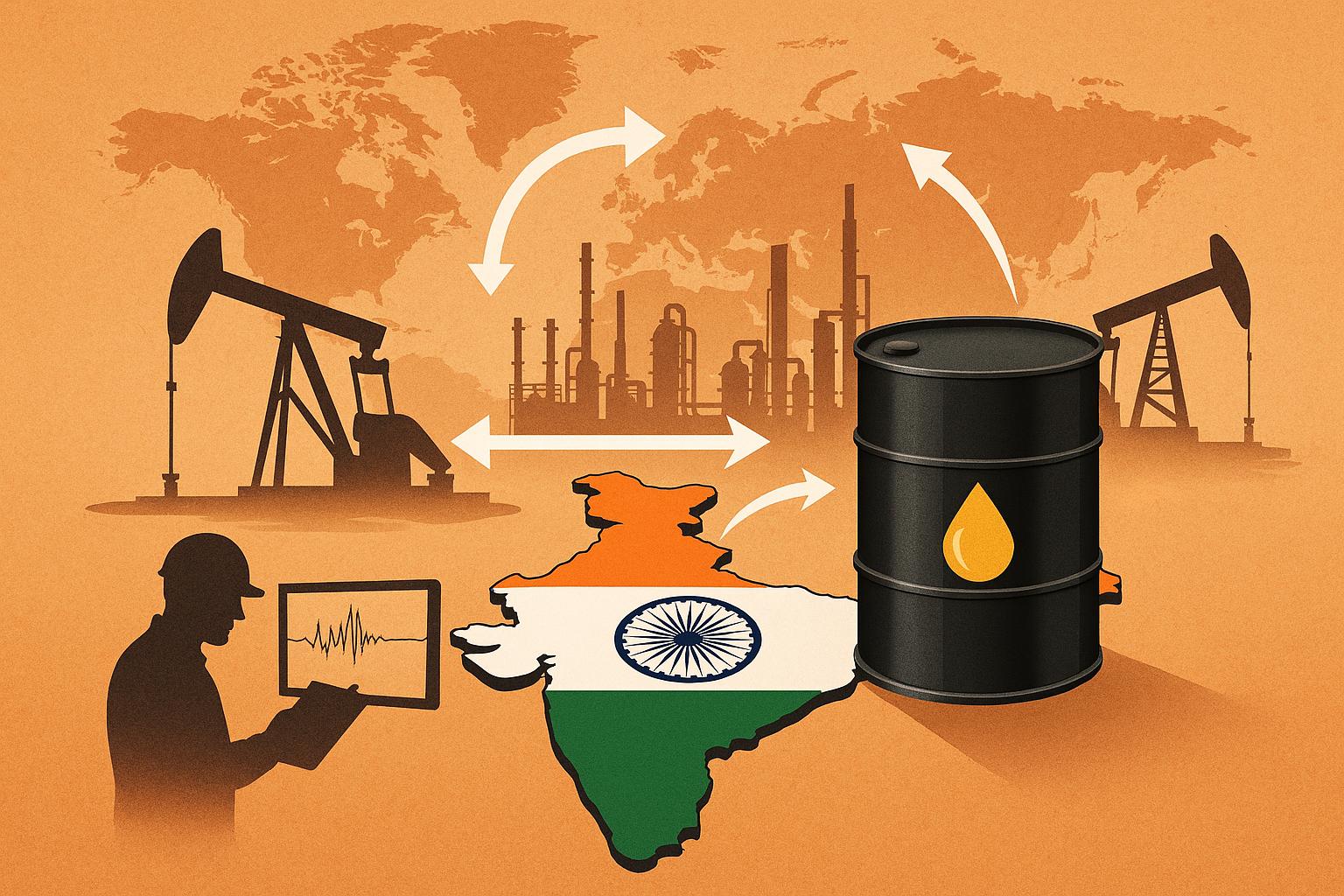
India’s Energy Security: A Geopolitical Vector Shaped by 85% Crude Oil Imports
Historically, India’s Energy Security challenge has continued to afflict the country’s GDP for decades. However, for the first time, this vulnerability of energy demand has transcended beyond a fiscal issue to become a determinant of India’s geopolitical stance. The dynamically and unpredictably varying turbulent geopolitical environment demands India to either take sides or retain its independent foreign policy. The recalibration of global issues and statecraft, while advancing economic and national strength, has never been so uniquely difficult.
With 85% of its crude oil imported, under the global situation, India’s energy security has transformed into a critical geopolitical vector. The question now is: who controls this strategic lever, and how will that shape India’s autonomy? Can India preserve its independent foreign policy, or will global energy politics compel India to go for an acceptable dilution of it?
Oil Outlook in India
India ranks as the world’s 3rd-largest consumer of crude oil but only 23rd in production. India spent almost 133 billion USD in 2023-24 Financial year to procure crude oil from Saudi Arabia, Iraq, Russia, US, UAE combined. Domestic output hovers between 540,000 and 700,000 barrels per day, just 0.7% of global supply, leaving a massive daily deficit of nearly 3.4 million barrels between what the country produces and what it consumes per day.
Proven reserves stand at roughly 4.6 billion barrels, while untapped resources are estimated at 22 billion barrels in underexplored basins. As of now, India has been exploring 10% of its sedimentary basin, which it plans to increase to 16%.
“ONGC and Oil India hold acreages in the Andaman waters under the Open Acreage Licensing Program (OALP) and have planned a few significant projects.”
Rahul Chauhan, An upstream analyst at Commodity Insights
“We have a total of 30 blocks under the OALP. We have already drilled all wells under the awarded OALP blocks, except in Nagaland. We are pursuing the ministry and they have set up a high power committee involving OIL, ONGC, government officials, to discuss the issue with the Government of Nagaland and resume exploration,”
Oil India Ltd
Expansion on Andaman Exploration
As a result of India’s efforts to boost domestic oil production, the Andaman and Nicobar Basin have emerged as a promising area for exploration, and recent developments indicate potential breakthroughs. In September 2025, Oil India Limited (OIL) announced the discovery of a significant reserve of natural gas in its shallow offshore block located in the Andaman Sea, specifically in the Sri Vijayapuram-2 well, located about 17 kilometers off the coast. The discovery, with estimated substantial reserves, is an important step towards reducing India’s import dependence and is considered a milestone in energy security.
Drilling continues amid high expectations, until early 2026, although challenges such as ultra-deepwater logistics and environmental concerns remain, underscoring the need for continued investment to convert discoveries into commercial production.
Strategic Petroleum Reserve (SPR) Of India
India currently has 5.33 MMT (39 million Barrel) Capacity in terms of SPR (Strategic Petroleum Reserve) at Visakhapatnam, Mangalore and Padur.
Government of India is planning expansion of SPR Capacity to 495 million barrels i.e. a 90days of net import cover.
What are SPRs?
These are crude oil reserves or stockpiles that countries maintain to deal with the risk of supply disruptions from natural disasters, war or other crises. Petroleum reserves are of strategic importance and the crude oil stored in them will be used in the event of oil shortages, when declared by the government.
Despite government efforts to accelerate exploration and improve output, analysts say India’s dependence on imported oil will carry on for the coming decades.
Oil price fluctuations & uncertainty has a direct and greater impact on India’s economy. When global crude prices moves up, India’s import bill swells, increasing the fiscal deficit and straining public finances. Higher energy costs impact the economy, fueling inflation and degrade consumer purchasing power, which leads to slow GDP growth.
The 2008 oil crisis saw India’s inflation soar above 11%, forcing stringent monetary tightening and dampening growth. More recently, during the 2022 Russia-Ukraine war, Brent crude prices crossed $120 per barrel, pushing India’s trade deficit to record highs and initiating a sharp depreciation of Indian currency. These previous experiences underscore how oil import dependence exposes India to external shocks, making energy security a critical determinant of macroeconomic stability
Why is India’s Oil Procurement a Geopolitical Vector today?
India’s dependence on the middle east oil producers, discounted Russian crude and US sanctions create a situation wherein every decision taken by India is carrying geopolitical consequences.
US has already imposed high tariff (50%) on Indian products imported into US to show their unhappiness about India’s increasing import of Russian crude. The Indo-US ties are under severe pressure to flourish at this point. Apparently, India buying Russian oil is in middle of this sour situation.
India is also trying to use the weakness as a strength by using it as a beneficial lever to choose among many to obtain the best deal. As of now, India is navigating successfully, yet amid plethora of challenges like western allies, Russia and OPEC nations.
India’s oil procurement strategy has become a delicate challenge diplomatically. On one side are Middle Eastern OPEC countries, which remain India’s largest suppliers and influence global prices through production cuts. On the other side is Russia, which is providing crude oil at discounted rates amid Western sanctions. It is the lifeline for India’s energy security, but also a sensitive issue in global politics.
On the other hand, the United States and its allies are pressuring India to reduce Russian imports, and link energy-related options to broader strategic alliances. India has already absorbed the 50% tariff on Indian products sold in America.

Washington’s main concern is that discounted Russian crude, refined and re-exported by India, helps fund Moscow’s war effort. Beyond the 50% tariff that has hit Indo–US trade ties hard, this move also threatens the goal of achieving $500 billion in bilateral trade over the next decade.
Growing Trade Deficit between India & Russia due to Crude Import:
Silent tensions exist between New Delhi and Moscow over their rapidly growing trade deficit, which climbed to nearly $59 billion in FY 2024–25, primarily due to India’s import of discounted Russian oil. In August 2024, External Affairs Minister S. Jaishankar publicly pointed a $25 billion deficit in the April–August period due to crude imports, calling for urgent solutions to rebalance trade.
To manage this, India and Russia use a Rupee–Ruble settlement system instead of U.S. Dollars. When Indian firms buy Russian oil, they pay in Rupees, which are credited to Russian banks’ vostro accounts in India. A vostro account is simply an account held by a foreign bank with an Indian bank to handle local currency transactions. These rupees cannot easily be converted into Rubles or Dollars, so they accumulate. To avoid idle funds, Russia invests these balances in Indian government securities, infrastructure projects, and defense-related deals, ensuring the money circulates productively within India while maintaining bilateral financial stability.
However, deploying these reserves remains diplomatically sensitive as both nations seek ways to use them without upsetting trade or currency dynamics.
Why India & Russia use Rupee-Ruble Payment Mechanism (Vostro account system) Instead of USD?
There are many reasons for this. Primarily, India and Russia use the rupee-ruble payment system to avoid US sanctions. After Russia was banned by the US and the European Union (especially after the Ukraine conflict), transactions in US dollars became risky as it goes through Western controlled financial systems (SWIFT).
 India and Russia aim to achieve dollar-free trade to reduce dependence on the US dollar dominating global trade. This is in line with the broader trend of promoting local currencies in trade between BRICS countries. This facilitates bilateral trade. India imports large quantities of crude oil, coal, fertilizer and defense equipment from Russia. Paying in rupees and rubles simplifies transactions and can avoid currency exchange costs and volatility in US dollar exchange rates.
Using local currencies, both countries maintain greater control over their monetary policies and foreign exchange reserves. It also helps India to preserve its dollar reserves for other significant imports.
India exports medicines, machinery and tea to Russia, but imports oil and defense materials far more. Under this arrangement, Russia can deposit additional rupees in Indian banks or invest in Indian assets, thereby balancing trade flows.
Expansion on BRICS Initiatives
In the broader context of India’s oil purchasing strategy, BRICS initiatives have played an important role in advancing efforts to reduce dollar dependence, particularly in oil trade with Russia. By the end of 2025, the BRICS countries (which now also include new members) have made solid progress on an unified payments system, with pilot programs for cross-border settlements in local currencies already underway between Russia and China, as well as between India and the UAE. This is in line with India’s rupee-ruble arrangement, which helps it avoid Western sanctions and reduce dependence on the US dollar that dominates global trade. At the 2025 BRICS summit, leaders emphasized reducing dependence on the dollar practically through blockchain-based payment systems instead of a fully shared currency to facilitate smooth transactions in commodities like oil and fertilizers
India’s Issues with OPEC & Middle East Oil Producing Nations
India is facing several interconnected challenges with OPEC and Middle East nations due to evolving global oil politics which have direct impact on India’s Energy Security dimensions.
Production cuts by OPEC+ countries limit global supply, supporting oil prices. Minor cuts could also increase India’s energy import spending by billions of dollars annually, an increase of $ 1 per barrel adds about $ 1 billion to the import bill. This results in a rapid increase in fuel and transportation costs.
Rising crude oil prices place a burden on public finances through higher subsidies and rising current account deficits, especially if the realization of discounted Russian crude oil becomes difficult.
India has reduced its dependence on Gulf countries’ oil from about 65% in 2023 to about 55% in 2025, and increased oil purchases from the US and Brazil.
Lighter US / Brazilian crude oil is more suitable for domestic refineries, but these supply routes remain associated with tariff / DME risk and the refining margin may not be as good as that of Middle East crude oil.
Due to tensions in India-US relations over oil imports from Russia by India, Gulf OPEC members have gained diplomatic benefits by using energy partnerships.
India-Russia Ties
India cannot simply detach from Russia. The relationship is time‑tested, rooted in Cold War-era defense dependence and strategic autonomy, and reinforced recently by discounted energy flows; even as New Delhi diversifies, Russian-origin systems still form a large share of India’s inventory and supply chains for spares and munitions.
At the same time, Western capitals often misread India’s constraints and ambitions, viewing oil purchases, India’s Energy Security and legacy platforms through the Ukraine‑war lens, terming it as profiteering without fully accounting for the decades in which Washington and parts of Europe backed Pakistan militarily and diplomatically, a history that shaped New Delhi’s tilt toward Moscow.
India has, however, materially diversified, the 2016 IAF Rafale contract and the upcoming 2025 Rafale‑M naval deal with France, AH‑64E Apache attack helicopters, P‑8I Poseidon maritime patrol aircraft from the U.S., and Barak‑8/MRSAM air‑defense systems co‑developed with Israel, plus Make‑in‑India co‑production and maintenance scopes, indicate a broad transformation in sources and technology.
Even U.S. and European analysts acknowledge that transitioning away from Russian dependence is a multi‑year process: supply chains, training, doctrine, and interoperability were consolidated over decades and cannot be unwound quickly; progress requires time, steady financing, and zero sanctions shocks and, crucially, Western partners’ trust and respect for India’s security priorities and growth trajectory rather than rhetorical “friendship” that overlooks operational realities.
India is trying to balance energy & oil affordability with geopolitical autonomy. The rupee–ruble route and SRVAs (Special Rupee Vostro Accounts) keep trade moving without USDs, while RBI (Reserve Bank of India) rule changes help absorb rupee surpluses into Indian assets.
But the U.S. tariffs and sanctions, framed around Ukraine, have raised the cost of that balancing act slowing Indo–U.S. trade ambitions and intermittently thinning Russian flows to Indian refiners. Over the next year, the most durable path likely combines supplier diversification, data‑transparent use of SRVA balances, and renewed trade diplomacy to safeguard both energy security and export growth.