
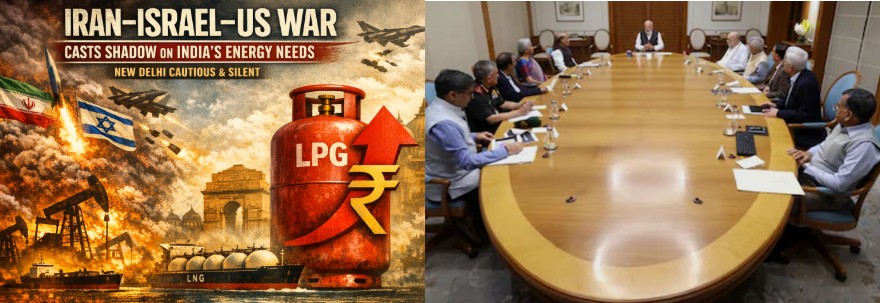
Iran–Israel–US War Casts Shadow on India’s Energy Needs: New Delhi Cautious & Silent
The Iran–Israel–US war has entered Day 8, with no signs of de‑escalation. The war has pushed West Asia and the Middle East into an extremely fragile security environment. Despite the immediate and deadly impact, including the killing of Iran’s Supreme Leader Ayatollah Ali Khamenei and several senior leaders, the larger strategic goals of regime change, or destroying Iran’s ballistic‑missile capability remain far from achieved. Iran continues its retaliation and claims to have control over the Strait of Hormuz, rapidly turning the crisis into a major threat for global energy markets, especially for countries like India and China.
While Iran’s IRGC appears lenient toward Chinese tankers, India’s position is far less certain. Nearly 45% of India’s crude oil imports pass through the Strait of Hormuz, making this disruption a serious concern. Yet New Delhi has chosen not to criticize Israel amid the escalating conflict. The timing, of the Indian Prime Minister’s visit to Tel Aviv, just before the war started, has added further ambiguity to India’s position. Iran has understood this shift.
How will India manage this evolving crisis & energy challenge. Let’s delve into this.

India’s Energy Procurement from the Middle East: The Hard Numbers
As per Petroleum Planning & Analysis Cell (PPAC), Ministry of Petroleum and Natural Gas, Government of India, nearly 46.9% (Approx 97 MMT) of India’s crude oil imports, is procured from the middle east countries. About 2.5 to 2.7 million barrels of India’s oil passes through the strait of Hormuz per day, primarily from Iraq, Saudi Arabia, the United Arab Emirates, and Kuwait.
India imported about 25 million tones of LNG last year, of which about 14 million tones were imported through the Strait of Hormuz, making it among the world’s biggest LNG buyers along with China, Japan and South Korea. In 2025, India sourced approx. 26 MMT LNG only from middle east, primarily from Qatar, UAE & Oman.
U.S. has serious objections on India buying cheap oil from Russia, although there are reports that U.S. may keep their reservations in abeyance temporarily due to ongoing crisis, i.e. Iran–Israel–US war.
“The risks around Hormuz are worrisome, I’m not that worried about crude oil, but about LPG and LNG. “
Sumit Ritolia, an analyst at maritime intelligence firm Kpler
Former Ambassador of India to Iran, Shri K.C. Singh, has written, in his article on The Tribune, India may also suffer losses diplomatically. Having tacitly but clearly aligned itself with Israel, India’s influence will be diminished if Iran’s Islamic regime persists.
If the Iranian regime persists & it continues to follow the path shown by their slain supreme leader Ayatollah Ali Khamenei, it would be a major blow to India’s long-term moral and strategic neutrality and independent foreign policy, in addition to the pressure on India’s energy sourcing versatility. India may not be well‑placed to expect diplomatic or strategic support from Iran; in any future conflict it becomes a part of.
 India also stands to lose from these developments. Prime Minister Narendra Modi’s unwillingness to criticize Israel during his recent visit, days before the attacks, has robbed India of its neutrality. Iran is unlikely to forget it.
KC Singh, Former Indian Ambassador to Iran
As per reports, India has a crude oil reserve sufficient for only 25 days, and the situation is worse in the case of gas, where the reserve appears to cover just 3 days. This is a precarious situation, as evident from the recent increase in the price of domestic and commercial LPG cylinders.
“Coming on the heels of US pressure to reduce Russian oil imports, New Delhi will seek to further diversify its energy partnerships, including with the US, Venezuela, and in Africa. The conflict will also create compulsions for India to keep energy ties with Russia on a stable footing for the time being, although New Delhi is likely to be more sensitive to reactions from the US than Beijing.”
Basant Sanghera, a managing principal at The Asia Group
But Russia is no longer offering India the earlier level of discounts on oil.
Since the 2022 invasion of Ukraine and subsequent Western sanctions, Russian Urals typically sold at much lower prices, often $15 to $30 a barrel less than Brent crude. Now traders say that for delivery in March and April 2026, Russian crude is selling $4 to $5 per barrel higher in India on a Delivered at Place (DAP) basis. The reversal is due to a sudden surge in demand as Indian refineries, including Indian Oil Corporation and BPCL, struggle to compensate for the 1.4 million barrels per day of crude from Iran and Gulf countries stuck in the Strait of Hormuz.
Energy markets have already triggered a rapid reaction after the Iran–Israel–US war. By the beginning of March, global oil prices had risen by about 12% to about $82 a barrel, from between $65–67 before the war began. Qatar Energy said it would halt production at the Ras Laffan plant following the Iranian attacks. Qatar Energy also stopped production of downstream products and declared force majeure on its own gas exports.
Countries like India, whose economies are heavily dependent on energy supplies from the Gulf countries, are likely to feel the heat of this war the most. The broader lesson for policymakers in India and the Global South is clear: They cannot afford to remain passive spectators of geopolitical conflicts in critical regions.
While China has several measures to mitigate the impact on its substantial energy imports from the region, including huge reserves of crude (SPR Of 1 billion Barrels), increased domestic gas and renewable energy production, as well as a strong coal base, analysts say its Asian counterparts have less room to maneuver, at least in the short term. China can keep itself insulated from the energy shock for at least 6 months.
 “Indians are very price sensitive, so I don’t know to what extent they are ready to pay much higher prices, they will be short in both oil and gas, however, but this will come at a huge cost.”
Anne-Sophie Corbeau, Gas Market Specialist at Columbia University
The Shock to Indian Rice, Sugar, Spice & Tea Exports to Iran & Middle Eastern Nations:
Iran accounts for about 25 per cent of India’s basmati rice exports and Iraq 20 per cent – totaling more than 2 million tones, valued at more than $2 billion – while India also exported tea worth about Rs 7 billion to Iran in 2024-25, all these exports are now impacted by disruptions in shipping routes, insurance or payments.
India’s sugar and sugar‑confectionery exports valued at approximately USD 4 million, as well as spice exports worth nearly USD 75 million, now stand obstructed in the wake of the Iran–Israel–US war.
Based on official information, Indian Government convened the Cabinet Committee on Security on March 2 to review the security of crude oil supplies, shipping routes and Indian citizens in the region. As per reports, the discussions included issues such as sea route security, contingency source options, adequacy of strategic petroleum reserves and the security of about nine million Indians in West Asia. Indian Officials are focusing on protecting the economy from instability and maintaining continuity of supply.

A destroyed Iran is not in India’s interest. Energy markets will wobble, maritime safety will become uncertain, and Russia may not be able to supply discounted oil for a sustained period. India must accelerate renewable‑energy expansion, expedite exploration for domestic crude reserves, and build greater capacity to influence geopolitical developments.
Along with the entire global south, India is living through decision cycles with a kill chain situation and extreme volatility. There is little scope for rhetorical exaggeration or cozying up to either Zionism or Sufism. There is even less room for miscalculation. In a gloom-ridden world, where the multipolar order is still taking shape, independent foreign policy is in test, balance is perhaps the most important strategic asset. India must go beyond talking about national interest; it is time to act clearly and visibly.