
Dragging the Arabs into a war for someone else’s interests: Russia. Iran Closes Strait of Hormuz
Russia on Thursday accused the US and Israel of dragging Arab states into a broader Middle East conflict by provoking Iran and said there were no signs of Washington and Tel Aviv backing down.
The Gulf Arab states, all close US allies, some of which also have close ties to Russia, have been hit by Iranian drone and missile attacks since the US and Israel launched airstrikes on Iran on Saturday.
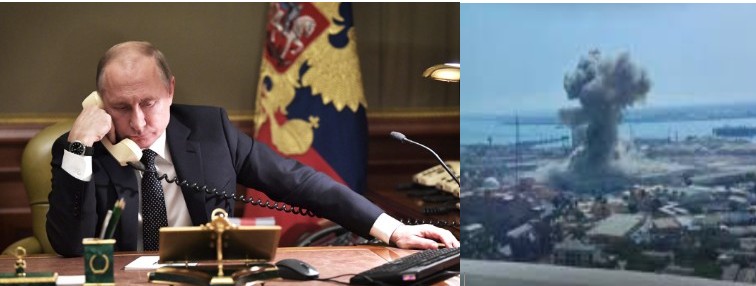
Russian President Vladimir Putin spoke by phone with the leaders of four Arab Gulf states on Monday and offered to use Moscow’s strategic connections with Iran to express concerns about Tehran’s attacks on oil infrastructure across the region.
Russia’s Foreign Ministry in a statement on Thursday accused the US and Israel of deliberately dragging Arab Gulf states into a wider conflict.
“They deliberately provoked Iran into retaliatory strikes against targets in some Arab countries, which led to human and material losses, which the Russian side deeply regrets, in doing so, they (Washington and Tel Aviv) are trying to drag the Arabs into a war for someone else’s interests”
Foreign Ministry of Russia
Iran continues to attack U.S. interests & Energy Infrastructure in Gulf nations
Saudi Arabia’s Aramco on Monday shut down its largest domestic oil refinery following Iranian drone attacks. Qatar’s state energy company Qatar Energy, one of the world’s top natural gas producers, halted LNG production following Iranian attacks on its two main gas processing bases.

Qatar Energy, Qatar’s state energy company and the world’s largest liquefied natural gas (LNG) producer, announced on Monday that it has halted LNG production following Iranian attacks on its operational facilities located in Ras Laffan and Mesaieed, Qatar.
Airports in the United Arab Emirates’ Abu Dhabi and Dubai have been targeted, as well as airports in Erbil, the capital of Iraq’s autonomous Kurdish region. Officials have blamed Iran for the attacks, although Tehran has not publicly claimed responsibility for the attacks on these airports.
Bahrain said the missile attack targeted the headquarters of the US Navy’s 5th Fleet, which is based in the capital Manama.
Abdullah al-Rajhi, spokesman for the General Authority of Civil Aviation in the State of Kuwait, said that a drone targeted Kuwait International Airport, causing minor injuries to several employees and physical damage to the passenger building.
Iran Closes Strait of Hormuz
Iran’s Islamic Revolutionary Guard Corps (IRGC) has said it has full control over the Strait of Hormuz, where US President Donald Trump has said he is willing to deploy the Navy to provide security for tankers.

“Currently, the Strait of Hormuz is under the complete control of the Islamic Republic’s Navy,”
IRGC Navy
About one-fifth of the world’s oil is transported through the vital narrow waterway.
Amid Iran’s tight controls on the movement of tankers through the strait, Brent crude prices rose to more than $82 a barrel, an increase of more than 13 percent since the beginning of the conflict and the highest level since July 2024.
The Islamic Revolutionary Guard Corps (IRGC) said on Thursday it had targeted a US oil tanker in the north of the Gulf with missiles.

Earlier, IRGC Navy also struck the oil tanker MKD Vyom in the Gulf of Oman by using uncrewed surface vehicle. After the strike, the ship exploded and then caught fire.
“UKMTO has received confirmation that the vessel was attacked by an Uncrewed Surface Vehicle (USV), and that the crew has been evacuated to shore,”
Since the launch of Epic Fury, ship movements passing through this vital waterway have declined by approximately 85%, and many ships have turned off their transponders to avoid being tracked.
While on one hand Iran is attacking tankers, on the other hand America is attacking Iranian naval ships. US President Donald Trump has said that the main objective of the Epic Fury campaign is to completely destroy Iran’s navy and so far 10 Iranian ships have been destroyed.
Meanwhile, about 500 ships, accounting for 1 percent of global total tonnage, are currently “waiting” in ports off the coasts of the UAE and Oman outside the Gulf. For now, no one knows how long the War will last, but the war will remain a major threat to commercial shipping.