
It’s about Oil, Not Cocaine — US Abducts Venezuela Prez Maduro as 2026 Begins
It’s about Oil, not Cocaine or so the U.S. President Donald Trump suggests.
Speaking to reporters after the 3 January 2026 operation in which U.S. Special Forces abducted Venezuelan President Nicolás Maduro and brought him to the United States, President Donald Trump asserted his imperious intention to ‘run’ Venezuela and secure its vast oil reserves, a policy that critics argue reflects strategic economic ambitions rather than counter‑narcotics priorities
Until now, President Donald Trump and his officials had maintained that the continued rhetoric and military action against Venezuela were aimed at curbing narcotics trafficking and preventing the flow of cocaine or fentanyl into the United States.
However, the world increasingly sees through this pretext, recognizing a far deeper strategic motive. Venezuela holds the world’s largest proven oil reserves with 303 billion barrels valued at roughly 18 trillion dollars, a sum exceeded only by the GDP of the United States and China.
It was never about cocaine. If narcotics were the true concern, the focus would be on strengthening the DEA, auditing the effectiveness of CBP, or examining failures within the U.S. Coast Guard — not abducting the president of a sovereign nation. This geopolitical event underscores how rapidly shifting global dynamics are bullying rule‑based diplomacy, uncovering a weakened UN, and ruining the conscience that once secured international affairs.
It is a sobering truth that we now live in a world increasingly steered by power over principle.
What happened in Venezuela on 3rd January 2026?
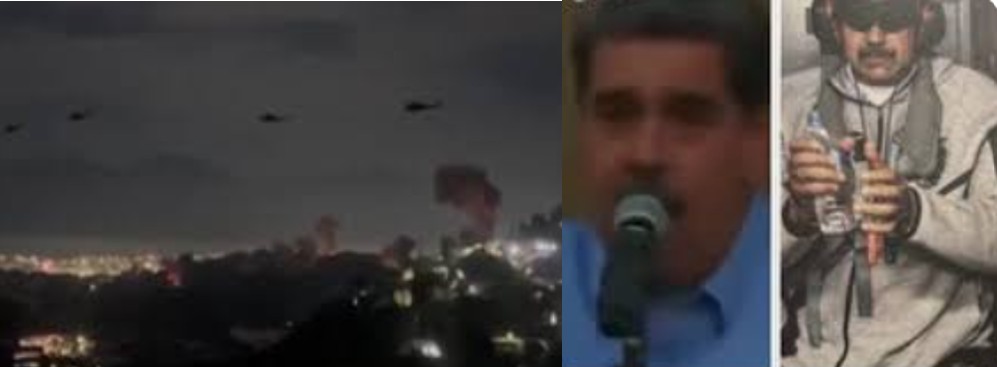
U.S. Special Forces launched Operation Absolute Resolve on 3 January 2026, striking both military and civilian targets across Venezuela, including the capital, Caracas. In a pre‑dawn raid, they breached President Nicolás Maduro’s heavily guarded compound at Fort Tiuna, abducted him and his wife, and flew them to the United States. Reportedly, most of the security personnels at Fort Tiuna have lost their lives.
 Maduro was indicted in the Southern District of New York on charges including an alleged ‘narco‑terrorism conspiracy’ and ‘cocaine importation conspiracy,’ because of which President Trump ordered U.S. forces to conduct an operation to capture the Venezuelan President.
U.S. Special Forces deployed nearly 150 aircraft that probably included MH-47 Chinooks & MH-60 Black Hawks, along with an unknown number of fighter jets, and the naval vessel USS Iwo Jima (LHD‑7), operating in close coordination with the CIA, Delta Force, the NSA, the DEA, and other special units.
Venezuela’s primary air base, La Carlota, was struck by multiple missiles, causing immense damage to military assets, infrastructure, and the air‑defense systems stationed there. The strikes reportedly destroyed anti‑aircraft units and other defensive vehicles, eliminating the base’s ability to initiate any resistance during the 30‑minute assault on Venezuela.

US would run the country for now, rebuild oil infrastructure, and take out a tremendous amount of wealth out of the ground” to sell to global customers
Donald Trump, President of the United States
Where is Nicolas Maduro Now?
Nicolás Maduro is currently imprisoned at the Metropolitan Detention Center (MDC) in Brooklyn, New York, awaiting federal trial.
“Since they can’t accuse me or accuse Venezuela of having weapons of mass destruction (like in the case of Iraq), they have invented a claim that the US knows is false,”
Nicolas Maduro, President, Venezuela
The Crude Truth of Crude Oil
According to analysis by The New York Times and Climate Power, during the 2023-24 presidential election campaign, oil and gas companies provided financial support to Donald Trump’s political system between $75 million and $96 million.
As per, The Times/Climate Power estimate, about $75 million came to the Trump campaign, the Republican National Committee, and its affiliated committees, while Climate Power’s larger estimate put the direct contribution to Trump’s support at about $96 million – this figure includes campaign and super PAC donations made between January 2023 and November 2024 and is a far cry from the much larger fossil fuel influence program of $445–$450 million. portion, which also included lobbying and advertising expenses.
According to separate reporting based on OpenSecrets, the industry’s direct, publicly trackable donations to Trump’s campaign structure as of early November 2024 totaled more than $20 million, highlighting the methodological differences between committee level and watchdog groups in tracking dark money-related spending.
Following Trump’s victory, the energy sector’s contribution continued into the inauguration period. According to NBC News (April 21, 2025), Chevron, ConocoPhillips, ExxonMobil, Shell, and Occidental Petroleum each contributed at least $500,000 to the 2025 inaugural committee, while further revelations reported by Rolling Stone (January 31, 2025) and Newsweek (February 7 and April 29, 2025) Chevron’s $2 million, ExxonMobil’s $1 million and Occidental Petroleum’s $1 million were reported as among the largest individual corporate donations.
In July 2025, an analysis of Federal Election Commission filings by Global Witness, confirmed by Common Dreams, concluded that fossil fuel donors collectively contributed more than $19 million to the inaugural fund, with Chevron, ExxonMobil, ConocoPhillips, and Occidental Petroleum among the major contributors.
In 1976, Venezuela nationalized the oil operations of foreign companies. American companies ExxonMobil, Chevron and Gulf Oil suffered losses of about US$5 billion and were later compensated about only US$1 billion.
A series of legal changes initiated by former Venezuelan President Hugo Chávez in 2007 were intended to give the state greater control over oil production projects and their associated royalties. These reforms triggered international arbitration lawsuits led by ConocoPhillips and ExxonMobil, both of which continue to seek compensation for the loss of their investments. Venezuela had begun making payments toward the arbitration awards but halted them after U.S. sanctions were imposed.
Chávez, and later his successor Maduro, have used these controversial events to unite people in the historic battle for Venezuelan crude.
When the Russia‑Ukraine war began, the U.S. government eased certain sanctions on Venezuela’s oil sector and granted a special authorization to only one American company Chevron as an exception, allowing it to form joint ventures with Venezuela’s state oil company, in accordance with Venezuelan law. This move was intended to secure additional oil supplies for the United States and its allies to help offset the shortfalls caused by sanctions on Russian oil.
It essentially functioned as a sanctions trade‑off: the United States partially relaxed its sanctions on Venezuela’s oil sector while it imposed sweeping sanctions on Russian oil, allowing Venezuelan supplies, primarily through Chevron’s authorized operations, to help offset the shortages created by restrictions on Russian crude.
In summary, Venezuela’s nationalization laws placed all drilling assets under state control but left the country without access to modern extraction technology. After suffering significant losses during nationalization, American private oil companies understandably withheld advanced technology critical for efficient production. As a result, Venezuela continued producing oil, but at much higher costs and even joint ventures such as Chevron’s saw limited financial benefit. Other U.S. oil companies were left without any business in Venezuela and are still awaiting arbitration awards and compensation for their expropriated assets.
Access to affordable oil remains critical for the United States. The Russia‑Ukraine war shows no sign of ending, and Donald Trump has failed to stop it. He has pressed other countries to stop buying Russian oil but has not provided them with a viable and crucially, affordable alternative. At the same time, his push to revive U.S. manufacturing makes cheap energy even more essential for domestic industry. In this context, Venezuela became a low‑hanging option for Trump: a way to ease oil‑supply pressures despite the moral questions, the international legal complications, and the political optics surrounding engagement with Caracas.
Beyond the Oil, It’s Monroe Doctrine
Beyond the Oil, the move brings new life to the Monroe-Doctrine logic: strategically deterring U.S. superiority and rival influence in the Western Hemisphere to offset foreign power presence, especially that of China and Russia, with the administration’s rhetoric clearly presenting Latin America as U.S. territory and Venezuela is probably the first test. In short, Trump’s decision sits at the pivot of energy-demand and hemispheric superiority restoration strategy.
US will brutally use force to open the world’s largest reserves to American companies, while simultaneously reasserting regional dominance.
Russia and China may view this as a consolidation of power, but the deeper reality is already well understood by both. They recognize and partly cause it & know that the international order is shifting, leaving weaker states increasingly exposed. Russia & China are part of it directly or indirectly.
As seen in Ukraine earlier, Venezuela today, and potentially Taiwan tomorrow, countries without significant military strength (to be truthful, without nuclear bomb), face growing vulnerability as great‑power competition builds up, making the future more uncertain and geopolitically volatile.
“We have never believed that any country can act as the world’s police, nor do we accept that any nation can claim to be the world’s judge, The sovereignty and security of all countries should be fully protected under international law”
FM Wang Yi, China
What is United Nation Doing?
The UN has once again exposed its structural weaknesses, merely expressing “deep concern” rather than taking decisive action over US attacks in Venezuela. Despite the seriousness of a permanent member of the Security Council launching a military operation without authorization and capturing a sitting head of state, the UN response was limited to statements calling for restraint and adherence to international law.
The Security Council has no relevance in this case as well, as expected, because only one of its veto-power members was the attacker, so the UN could neither condemn the action nor initiate any meaningful intervention. The incident shows the organization’s repeated inability to act when major powers violate sovereignty, reinforcing old criticisms raised during the crises in Iraq, Ukraine and now Venezuela.
Given this pattern, the need for reform of the UN has become inevitable, especially through changes in the veto power and inclusion of additional representative members, to curb the growing global trend of “whose stick is his buffalo” and restore the credibility of international law.
“The Secretary-General is deeply alarmed by the recent escalation in Venezuela, culminating with today’s United States military action in the country, which has potential worrying implications for the region,”
Stéphane Dujarric, UN Spokesperson
The U. S. operation in Venezuela has revealed one of the most uncomfortable truths about the world we live in, that power takes precedence over principle, over the rules, over institutions, and even over diplomacy. With Washington blatantly pursuing oil interests under the disguise of counternarcotics, and with Russia and China both growing their own sphere of influence, the international system is slowly moving away from the post, Cold War era of respect for law and rights towards one of more direct confrontation and use of force.
China calls on the US to ensure the personal safety of President Nicolas Maduro and his wife, release them at once, stop toppling the government of Venezuela, and resolve issues through dialogue and negotiation.
Foreign Ministry, China
We call for immediate clarification of this situation. Such actions, if they did indeed take place, constitute an unacceptable violation of the sovereignty of an independent state, respect for which is a key principle of international law.
Foreign Ministry, Russia
Venezuela’s suffering is not just a single story. It is a warning for all the weaker countries that are the pawns in the great power chess game, be it Ukraine and the whole of Eastern Europe or Taiwan and the Western Pacific. The United Nations, standing in the middle of this changing world, has once again shown its powerlessness to react in a way that matters when a permanent member of the Security Council is the one that breaches the very principles that it was founded on.
“India reaffirms its support to the well-being and safety of the people of Venezuela. We call upon all concerned to address issues peacefully through dialogue, ensuring peace and stability of the region,”
Ministry of External Affairs, India
If the world community is serious about upholding international law, stopping one sided military actions, and safeguarding the sovereignty of every nation, then getting serious about UN reform, especially the veto structure, cannot be delayed any longer. Without such a change, the case of Venezuela might be recalled not as an exception, but as a precedent.