
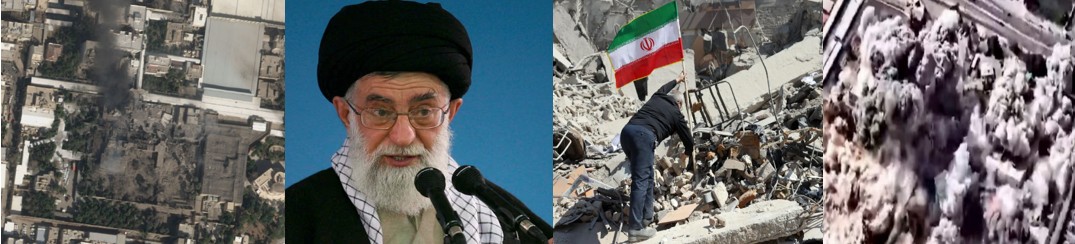
US-Israel Strike Iran on 28th Feb 2026: Supreme Leader Ayatollah Ali Khamenei Killed; Iran Retaliates
The United States and Israel launched joint air strikes against Iran on February 28, 2026, resulting in the death of Iran’s supreme leader, Ayatollah Ali Khamenei. his intensifying geopolitical crisis has unfolded after the US–Iran negotiations, facilitated by Oman, failed to satisfy the conditions stipulated by the United States.
Along with Iran’s Supreme Leader, Ayatollah Ali Khamenei, several senior officials have also lost their lives, in what is being described as a highly coordinated operation allegedly involving the CIA and Mossad. The joint operation has been designated by the United States as ‘Operation Epic Fury,’ while Israel has referred to it as ‘Operation Lion’s Roar’.
Iran, in a fit of rage after violation of its sovereignty and assassination of its supreme leader & other top leaders, has responded with Operation Truthful Promise 4. Iran has, as of now, attacked Saudi Arabia, Qatar, Bahrain, Kuwait, Cyprus, Israel, and the UAE, essentially all locations within its strike range that host U.S. military bases or U.S. interests. Is Iran responding impulsively, or is there a calculated strategic rationale guiding its actions? Let’s examine this more closely.
Initial Joint Strike by U.S. & Israel- Targeting Iranian Leadership
The campaign authorized by U.S. President Donald Trump began with precision air strikes on key Iranian sites in Tehran and elsewhere. Initial reports confirmed that Ayatollah Ali Khamenei, who had ruled Iran for 36 years, was killed in the first wave of strikes, along with members of his family and 40+ senior officials.

The attacks also targeted nuclear enrichment plants, ballistic missile deployment locations, and government buildings, including Iran’s state broadcaster, allegedly a girls’ school and a UNESCO World Heritage site. U.S. Secretary of Defense Pete Hegseth justified the action by saying Iran’s “nuclear activities” and its arsenal of missiles and drones had become “no longer tolerable.”
Khamenei, one of the most evil people in History, is dead. The heavy and pinpoint bombing, however, will continue, uninterrupted throughout the week or, as long as necessary to achieve our objective. I will not allow Iran to possess nuclear weapons.
Donald Trump, President of the United States
Israeli Prime Minister Benjamin Netanyahu reiterated that the purpose of these airstrikes was to “maintain control of the skies” and to neutralize threats coming from Iran. Intelligence sharing between the United States and Israel played a significant role, with CIA providing real-time location data on Ayatollah Ali Khamenei and his close associates. By the fourth day of the campaign, the death toll in Iran had risen to more than 550, including civilian casualties from strikes on residential areas such as schools, where reportedly over 168 girls were killed.
We are defending ourselves; whatever it takes; and we see no limit for ourselves to defend our people, to protect our people. We are defending ourselves, and we have every right, every legitimate right, to defend ourselves
Iranian Foreign Minister Seyed Abbas Araghchi
A short while ago, Israel and the United States embarked on a joint campaign, Operation Lion’s Roar. The aim of the operation is to put an end to the threat from the Ayatollah regime in Iran.
Israeli Prime Minister Benjamin Netanyahu
Weapons Used by the U.S. & Israel:

U.S. Navy destroyers launched an undisclosed number of Tomahawk Land‑Attack Cruise Missiles (TLAMs), followed shortly thereafter by U.S. Navy aircraft carriers deploying F‑35C Lightning II and F/A‑18E Super Hornet fighters armed with air‑launched munitions, integrated with CENTCOM’s one‑way kamikaze drones.
Simultaneously, the Israeli Air Force (IAF) fired long‑range precision missiles based on intelligence provided by the CIA and Mossad. The entire first wave of the operation culminated in a deadly and highly precise decapitation strike that ended the rule of Iran’s Supreme Leader, Ayatollah Ali Khamenei.

Subsequently, to suppress Iran’s response, the U.S. and Israel have continued to pound Iranian targets with heavy airstrikes. According to reports, the U.S. Air Force has deployed B‑1 and B‑2 bombers to carry out precise, stealth operations using heavy GBU‑57 bunker‑buster munitions aimed at destroying Iranian ballistic‑missile sites and nuclear facilities.
Iran’s Retaliation:
In response, Iran launched a fierce retaliation campaign, Operation True Promise‑4, firing over 400 ballistic missiles at Israel and U.S. military bases across the Gulf, along with nearly 1,000 drones.

Iranian missiles and drones struck the U.S. Navy’s 5th Fleet headquarters in Bahrain, as well as U.S. air bases in Saudi Arabia, Qatar, Iraq and Kuwait. As per current reports, the United States has suffered 4 confirmed service‑member deaths, several seriously wounded, and the loss of 3 advanced fighter jets during the operation as of now.

At least 9 to 10 people have been confirmed killed in Iran’s missile strikes on the Israeli cities of Beit Shemesh and Tel Aviv, as Iran continues its retaliatory attacks across multiple Middle Eastern countries targeting military assets of Israel and the United States.
Iran’s retaliatory strikes also destroyed one of the United States’ most advanced strategic assets in the Middle East , the AN/FPS‑132 early‑warning radar in northern Qatar. The $1.1‑billion system, a key component of the U.S. long‑range missile‑warning network capable of detecting ballistic launches up to 5,000 km away, now stands damaged beyond recovery.
Energy facilities have been attacked as well by Iranian missiles & drones, in the United Arab Emirates, Kuwait and Saudi Arabia, including drone attacks on the U.S. embassy in Riyadh.
Iran supported groups have accelerated vengeance. In Lebanon, Hezbollah attacked Israel through the swarm of drones and rockets and vowed to avenge Ayatollah Ali Khamenei’s death. Tehran also consecutively announced the closure of Hormuz’s streamline, a significant tightening point for global oil supply, thereby increasing economic bets in the war. The attacks affected energy facilities of UAE, Kuwait and Saudi Arabia, including drone attack at the U.S. embassy in Riyadh.
Iran’s Retaliation is Chaotic or Calculated? Analyzing the Strategy
The initial response by Iranian forces, particularly the IRGC, reflected a rapid and emotionally charged retaliation, marked by aggressive and somewhat unsustainable attack patterns driven by anger over the killing of Supreme Leader Ayatollah Ali Khamenei. This led to direct strikes across neighboring countries, including Saudi Arabia, Qatar, the UAE, Bahrain, Kuwait, and Iraq, although the intended targets were U.S. military bases stationed in those states.
You have crossed our red line and must pay the price
Mohammad Bagher Ghalibaf, Speaker, Iran Parliament
Yet, as the operation continues, Iran’s actions increasingly suggest a calculated strategy rather than impulsive retaliation. How effective this approach proves to be will only become clear in the days ahead. Currently, it looks less chaotic and more Calculated.
Many independent analyses confirm that the US and Israel are consuming their air-defence interceptor missiles at a pace that isn’t durable for long-term regional war. Pentagon’s officers and Hill’s lawmakers are rising warning that long term attacks on Iran can stress the US military air defense reserves to the border and make the country more vulnerable.
The United States produces roughly 600 Patriot PAC‑3 MSE missiles per year, while THAAD interceptors are manufactured in extremely limited quantities only 11 in the previous fiscal year, with 12 expected this year. Analysts estimate that, given the rate at which these interceptors were consumed during the 12‑day Israel Iran war in 2025, the prior supplies made to Ukraine, and the current intensity of the war, it may take up to a decade to fully replenish depleted stockpiles.
Iran appears to be observing this dynamic closely and understandably, is deliberately firing lower tier ballistic missiles combined with low-cost armed drones to overwhelm and bypass U.S. and Israeli air‑defense networks across the Middle East. Visibly, IRGC’s intent is to wear down these air defense blocks by causing repeated interceptor launches, steadily depleting the stockpiles of Patriot, THAAD, Arrow.
In essence, Iran is trying to win an attrition contest, not in terms of missile quantity, but by exhausting the opponent’s ability to intercept them. This approach suggests that Tehran is deliberately preserving its advanced systems, including the Fattah‑1 and Fattah‑2 hypersonic missiles, the Khorramshahr/Kheibar heavy MRBMs, and the Sejjil solid‑fuel long‑range missiles, reserving them for a stage when U.S. and Israeli interceptor reserves fall below a critical threshold.
At the same time, Tehran has announced the closure of the Strait of Hormuz, signalling its intent through attacks on multiple oil tankers near the vital waterway. Iranian commanders have openly warned that they will ‘set fire’ to any vessel attempting to pass illegally, a threat that has already forced major shipping companies to halt transits Iran’s actions demonstrate a clear strategy, to pressure Middle Eastern states and global powers by disrupting a critical energy lifeline and inflicting worldwide energy and supply‑chain obstruction.
However, this is a dangerous strategic call for Iran, because U.S. and Israeli commanders clearly understand this approach. In response, they have intensified their airstrikes on Tehran to an even heavier level, and Prime Minister Netanyahu has already stated that this war will not be prolonged, a clear indication that Israel intends to escalate its offensive decisively and forcefully to achieve its objectives before Iran’s strategy can take full effect.
It may take some time, but it’s not going to take years. It’s not an endless war
Benjamin Netanyahu, Prime Minister, Israel
Ultimately, this struggle is driven by a mix of chaos and calculation. The success of the initial strike in eliminating Iran’s top leadership reflected a master plan, yet Iran did not surrender, nor did the battle end quickly as in earlier U.S. operations like the Venezuela operation. Instead, Iran’s continued retaliation has opened the door to a prolonged confrontation, introducing dangerous variables such as the risk of a drawn‑out war and far‑reaching economic disruption.
 Donald Trump has dragged the nation into War without a Plan- Senator Warnock
As President Trump threatens of a potential five‑week military campaign, the world watches anxiously to see whether diplomatic backchannels can prevent the situation from burning further.
Meanwhile, A bipartisan Senate effort to restrict President Donald Trump’s authority to conduct military operations against Iran was defeated, even as U.S. strikes continue. The Senate voted 53–47 to defeat the war‑powers resolution, mostly along party lines. The measure would have barred U.S. military operations against Iran without prior authorization from Congress.
 “It is so much worse than you thought. You are right to be worried. Trump Administration has no plan in Iran. This illegal war is based on lies and it was launched without any imminent threat to our nation.”-
Senator Elizabeth Warren
This crisis raises the grim prospect of an increasingly unstable Middle East, and with no immediate signs of de‑escalation, the international community can only hope for restraint before the conflict pushes the world closer to a global war.