
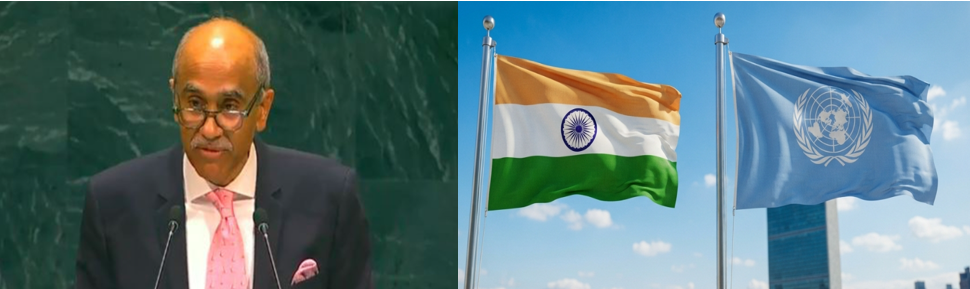
India Rejects Veto-Less Second-Class UNSC Member Status at United Nations, Demands Equitable UNSC Reformation
The Inter-Governmental Negotiations (IGN) plenary session at the United Nations on the veto power heard caustic criticism from India, which strongly rejected a compromise proposal aimed at creating a new category of permanent members in the UNSC without the power of veto. India told the United Nations that any reform creating permanent members without the veto would leave new members permanently relegated to second-class status, protecting the privileged position of the existing P5 members.
The Security Council has five permanent members – Russia, China, the US, Britain and France, who have the power of veto; In addition, there are 10 non-permanent members elected for a two-year term.
The Asia-Pacific region is home to more than 60% of the world’s population but has only one permanent seat; Whereas Africa and Latin America do not have any permanent representation. Earlier this year, the African Union formally introduced its reform model, which calls for at least two permanent seats with veto rights on the United Nations Security Council (UNSC) for Africa.
The G4 Alliance Countries i.e. India, Brazil, Japan & Germany have repeatedly called for discussions & negotiations to enhance the composition of permanent members by demanding full permanent membership with equal rights & identical Veto rights.
Ambassador Harish Parvathaneni, India’s permanent representative to the United Nations, on 26th October 2026, reiterated that, as long as the veto exists, it must be held by all permanent members of a reformed council.
 A new category of permanent members, with or without the veto, would only further complicate a discussion that’s already very difficult. and would further entrench the very inequity we are seeking to correct. We reiterate that as long as the veto exists, it must be held by all permanent members of a reformed Council. Fairness and justice demand that all permanent members enjoy the same rights and responsibilities.
A reform that expands the UN Security Council by creating another category of long-term members without the veto effectively makes them second-class members and would not change the decision-making dynamic of the P5.
Ambassador Harish Parvathaneni, India
Additionally, India described the 2022 “veto initiative” (UNGA resolution 76/262), which was intended to allow public debate after the use of the veto, to be ineffective. India pointed out that the number of uses of the veto has increased to 18 during 2022 to 2024, amid the ongoing conflicts in Ukraine and Gaza. India also criticized the use of “disguised vetoes” as a weapon and behind-the-scenes delays in sanctions committees.