
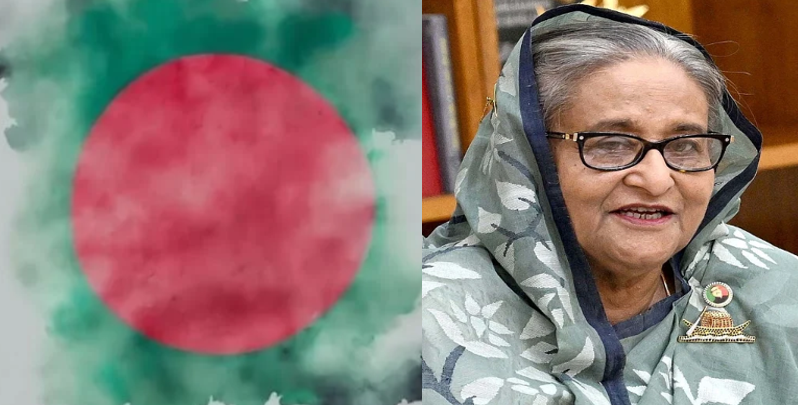
Will Sheikh Hasina Return to Dhaka? Moral Weight vs. Political Feasibility
Sheikh Hasina, former Prime Minister of Bangladesh, wants to return to Bangladesh. At the same time, Bangladesh also wants her back, but in handcuffs. Between these two wishes lies a Bangladesh still unhealed from the uprising of 2024, a country still struggling to decide what future it truly envisions.
More than two years after Ms. Sheikh Hasina was overthrown following a student-led uprising in August 2024, she has formally requested a new National Identity Card from the mission in New Delhi and a new Bangladeshi passport. She intends to return to Bangladesh in December 2026, surrender herself before a court of law, and face whatever awaits her there: arrest, imprisonment, or worse.
“If death is my destiny, I would rather die on the soil of my own country, among my own people, So, I will return to Bangladesh. That decision has not changed. I know that I may be arrested when I return. I may be imprisoned, tortured or even killed. I am fully aware of those possibilities. But I cannot spend the rest of my life watching my people suffer from a distance”
Sheikh Hasina, Former Prime Minister, Bangladesh
On the face of it, these do not appear to be the words of a politician calculating a political comeback. Rather, they seem to reflect the sentiments of someone who may have concluded that life in exile is no longer bearable, for reasons she alone can fully articulate.
Hasina bills her return as duty, duty to party workers she claims are being searched for, killed and forced into hiding; duty to a political tradition, which she says is being erased; Duty to the idea that a leader cannot leave a battlefield leaving his people suffering. She rejects the death sentence handed down in absentia by the International Crimes Tribunal in November 2025 as political vendetta
The Dhaka government has a different perspective. For the BNP administration under Prime Minister Tarique Rahman, the fugitive leader is seen as a dangerous figure who allegedly ordered the deaths of hundreds, possibly thousands, during the 2024 unrest. Authorities describe her as a terrorist and have refused to issue travel documents. They are demanding her extradition under the treaty with India. They argue that her request for a passport is a political maneuver, not an attempt to demonstrate responsibility, and is intended to further destabilize the fragile post-rebellion order.
 “She fled the country. There is no scope now for staging a drama about returning with a new passport. If she genuinely wants to return, there is a specific legal process for that. Bangladesh and India have an extradition treaty. Let her ask the Indian government to hand her over to Bangladesh under that treaty. She can then return, surrender before the court and serve her sentence,”
Bangladesh Foreign Affairs State Minister Humaiun Kobir
Recent incidents of bomb blasts and bus arson in Dhaka have increased the existing tensions. The Dhaka Metropolitan Police (DMP) has arrested 15 people during multiple operations in connection with the attacks and homemade bomb blasts targeting police in different areas of the capital. If it gets suspected or alleged to be orchestrated by supporters of Shaekh Hasina, this also poses a significant risk to her own supporters, who face the prospect of arrest in an environment of heightened surveillance and suspicion.
The Awami League has been banned. After two years of exile, arrest, and being barred from political activity, its organizational structure has been severely weakened. Ms Sheikh Hasina has no safe house, no military protection, and no political space. Analysts agree that there is no safe or secure route for her return, and that any attempt to return will likely result in an uncertain and unpredictable fate.
Is there any Merit in her Return?
Dismissing her move as pure delusion misses something important. Sheikh Hasina is not the first South Asian leader to treat exile as temporary. Political memory in the region is long, and banned parties have a habit of returning when the cycle turns. The deeper problem is that Bangladesh has not yet built institutions strong enough to manage such a return without sliding back into zero-sum confrontation. The 2024 uprising is followed by an incomplete transition: election that excluded the previous ruling party, a death sentence delivered in absentia, and residual networks still capable of disruption.
Hasina’s planned return has some narrow, arguable merits, but they are heavily outweighed by the political realities in Bangladesh today.
Returning to face the death sentence and other cases is, on paper, more accountable than remaining a long-term fugitive in India. An in-absentia verdict always carries a legitimacy deficit. This is the strongest argument in her favor. If she returns, surrenders & faces the court with her defense & fights for an amicable verdict, than keeping the case in a political limbo, will be healthier for the legal traditions of Bangladesh. Of course, it is fraught with risks to be calculated taking into considerations the situational aspects.
For remaining Awami League loyalists who feel abandoned and persecuted, her physical return, even into custody, signals that the leadership has not permanently deserted them.
But these merits are thin, risky and need deepest introspection, weighing the probable events in the next 10 years, to reach a conclusion.
India Sits Awkwardly in the Middle
India continues to host Sheikh Hasina but has not acted on requests for her extradition. New Delhi’s approach appears both pragmatic and provisional. It is reluctant to strain relations with a long-term partner and immediate neighbour at a time when bilateral ties are already difficult. Equally, India has sought to avoid triggering fresh political volatility along its eastern frontier.
Yet the calculus may not remain static forever. With recurring student-led protests in Delhi, a more assertive opposition, and growing debate over domestic issues, the political optics surrounding Hasina’s stay could become increasingly difficult to manage.
Every day she remains in India; Dhaka’s extradition request remains a diplomatic irritant. And with each public statement she makes from Indian soil, perceptions in Bangladesh are reinforced that New Delhi is providing refuge to a convicted former leader.
 “Nobody can give you a time frame (over Hasina’s return), Again and again, the government of India has replied to this that there is a process, and the process is legal, and it is well structured. At that point in time, she (Hasina) was still the prime minister of Bangladesh. We had hardly any choice on that. It was our duty as a neighbour to accept the reality of life, because situations are such where at times you are not prepared for it”
Indian High Commissioner in Bangladesh Dinesh Trivedi
Former Prime Minister Sheikh Haseena’s decision is ultimately a personal one. She is choosing the possibility of death or long imprisonment rather than the security of permanent exile. This choice holds moral significance, even for those who hold her responsible for the violence of 2024. But moral weight does not imply political feasibility. Does Bangladesh as a nation, need another high-stakes episode? It needs a difficult and slow process to create rules that allow exile leaders to return without destroying the entire system and for the state to prosecute serious crimes without turning the judiciary into a weapon of the beneficiary.
Unless this work is completed, Sheikh Hasina’s return home will be less a path towards a country which has not yet emerged from the meltdown in 2024. For many, protest is necessary. For Bangladesh, it will probably just sound familiar.